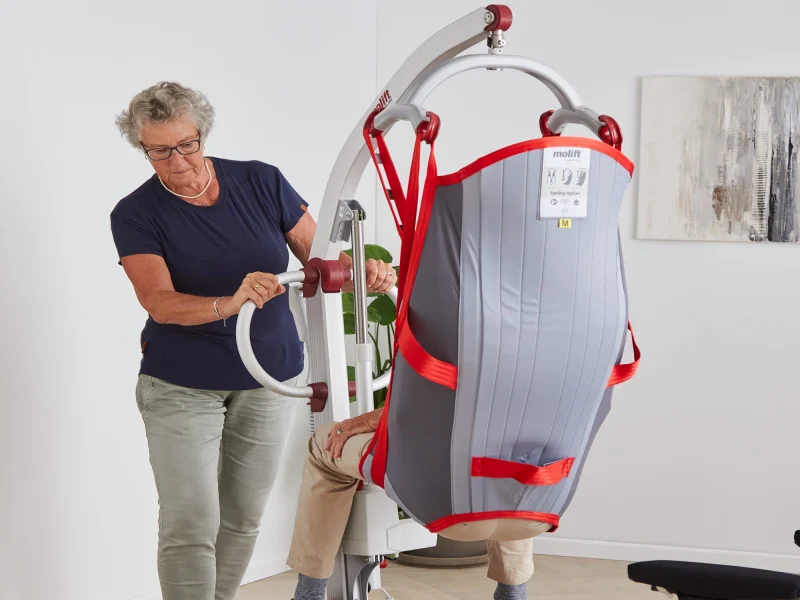

Within professional and home care, ensuring the dignity, independence and safety of individuals with mobility challenges is a primary concern. While it is common to associate patient transfers with traditional full-body hoists, standing hoists are now transforming care. At Revived Medical, we’re dedicated to providing innovative and reliable solutions that empower both caregivers and those they support. Standing hoists offer a unique blend of safety, functional support and encouragement.
What are standing hoists?
A standing hoist, also known as a stand-assist lift or sit-to-stand lift, is a piece of equipment designed to help individuals transition from a seated position to a standing position. Unlike a traditional full-body hoist that lifts a person entirely off the ground in a sling, a standing hoist provides support while the user remains partially weight-bearing.
Key features of standing hoists:
- Padded knee support to stabilise the user’s knees and provide a secure anchor point during the transfer
- Ergonomic support handles give the user a place to grip and actively participate in the standing process, promoting upper body strength and engagement
- Many modern standing hoists feature a motorised lifting mechanism to assist the user and reduce physical strain on the caregiver
- A wheeled base so the hoist can be easily moved between different locations
- A removable foot tray that provides a stable platform for the user’s feet, which is beneficial for rehabilitation exercises like gait training
Standing hoists are specifically designed for people who have some leg strength and can bear their own weight but need assistance with the initial push and balance required to stand. This makes them a perfect tool for promoting independence and maintaining a user’s existing mobility.
The benefits of using a standing hoist
Standing hoists are a powerful tool for holistic care that supports the user’s physical and psychological well-being. They offer:
Enhanced independence and dignity
These products empower users to be active participants in their own care. By helping them achieve an upright position, they can engage in daily activities with a greater sense of autonomy. This fosters self-esteem and a positive outlook.
Improved health and circulation
Regular standing can have significant health benefits. It helps to improve circulation, bone density and muscle strength. It also helps reduce the risk of pressure sores that can develop from prolonged sitting or lying down.
Increased social participation
For many, the ability to stand and move from a bed to a chair or wheelchair is a gateway to social interaction. Standing hoists make it easier for individuals to join in with communal activities, dine with family or simply change their environment, combating feelings of isolation.

Versatility in care
Standing hoists can be used for a variety of tasks beyond basic transfers, including toileting, dressing and therapeutic exercises.
Standing hoists for rehabilitation centres
Rehabilitation is a journey of regaining function, and standing hoists are an indispensable part of this process. They act as a bridge between passive care and full independence. In a rehabilitation setting, the goal is to help patients recover as much mobility and strength as possible.
For patients recovering from a stroke, surgery or a debilitating illness, the ability to stand can be a major milestone. Standing hoists allow therapists to safely assist with standing and gait training. The hoist provides the necessary support and stability, while the patient is encouraged to use their own muscle power. This active engagement is crucial for strengthening leg muscles, improving balance and rebuilding the neuromuscular pathways needed for walking. Some models even have features like removable foot trays that allow the user to take small steps, further aiding the rehabilitation process.
Standing hoists for the elderly and disabled
For the elderly and disabled, a standing hoist can be a life-changing piece of equipment. It allows them to maintain a level of function that might otherwise be lost. For those with conditions like Parkinson’s disease, muscular dystrophy or general frailty, standing can become a challenging and even dangerous task.
Standing hoists provide a secure and stable way to perform everyday transfers, whether it’s moving from a bed to a wheelchair in the morning or transferring to the toilet. This not only enhances the user’s quality of life but also provides peace of mind for both the individual and their family members. It significantly reduces the risk of falls, a leading cause of injury for older adults. The ability to stand with assistance means they can continue to engage in personal care routines with greater privacy and dignity.
Reducing work-related injuries for caregivers
Manual handling of individuals with limited mobility is a leading cause of musculoskeletal injuries for caregivers, including nurses and home care assistants. These injuries can be debilitating and lead to lost time at work and long-term health issues. Standing hoists are a proactive solution to this widespread problem.
By providing mechanical assistance, a standing hoist eliminates the need for a caregiver to manually lift a person’s full body weight. Instead, the caregiver simply guides the user and operates the hoist’s controls. This significantly reduces the physical strain on the back, shoulders and knees, promoting a safer and healthier work environment. The use of hoists also ensures that a single caregiver can often perform a transfer that would otherwise require two or more people. This improves efficiency and reduces the risk of injury for all involved.
Compatibility with textile slings
A standing hoist is only as effective as the accessories that work with it, and textile slings are a crucial component. Standing hoists typically use a specialised sling or support belt that wraps around the user’s torso or back. This sling connects to the hoist’s lifting arms, providing secure support during the transfer.
At Revived Medical, we understand that every individual is unique. That’s why we don’t just supply standard slings; we can also manufacture bespoke slings tailored to specific user requirements.
This might include:
- Custom sizing for users who don’t fit standard sizes
- Specialised materials such as padded fabric for extra comfort or mesh for bathing and toileting
- A bespoke sling can be designed to accommodate specific physical conditions to ensure maximum comfort and safety
The compatibility between the high-quality hoists we supply and our durable, comfortable textile slings is essential. For standing hoists, the sling often focuses on providing support around the chest and under the arms, allowing the user’s legs to remain free to bear weight. This combination of robust equipment and custom-designed slings ensures that we can meet the diverse needs of any care environment, from large hospitals to private homes.
Whether in a rehabilitation centre, a care home or a private residence, a standing hoist from Revived Medical offers a reliable, comfortable and dignified solution for safe patient transfers. By combining innovative hoist technology with our in-house expertise in creating bespoke textile slings, we provide a complete solution that is as unique as the individuals we serve.